


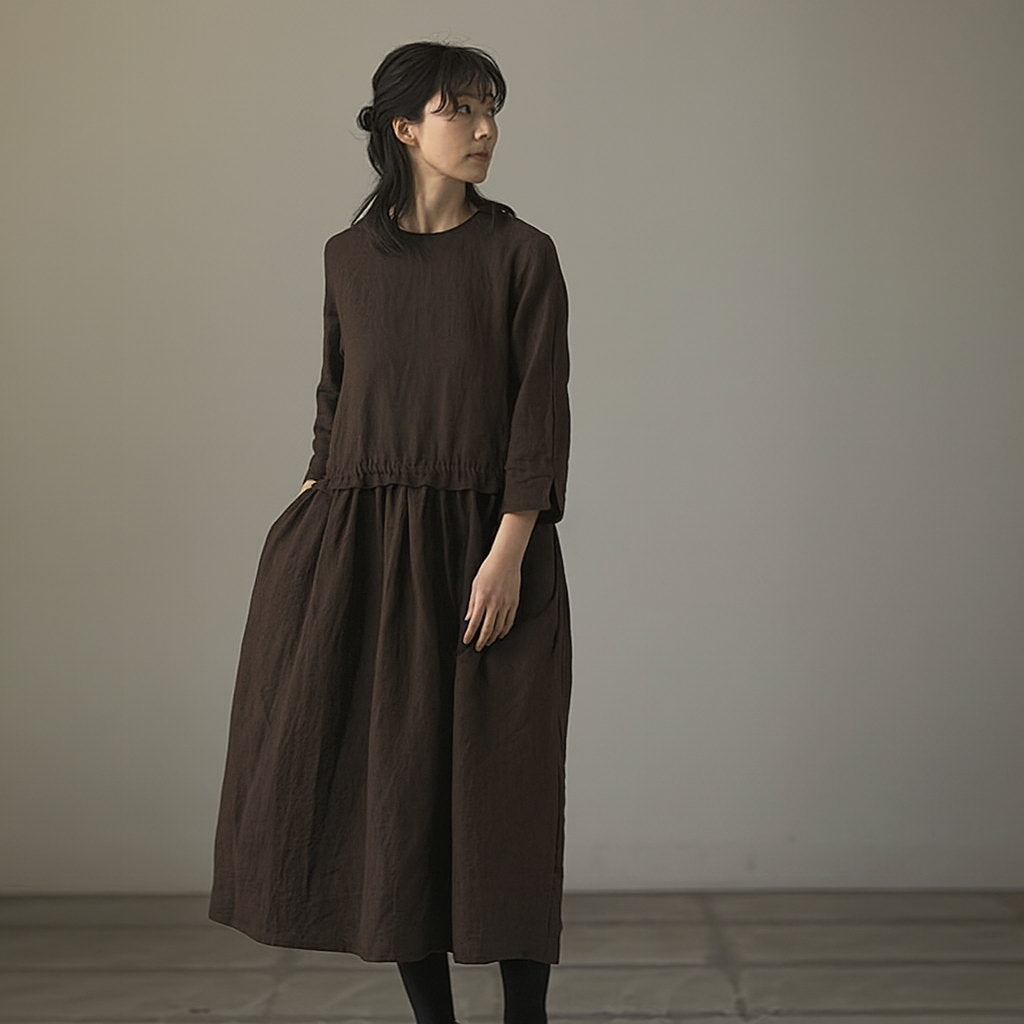

Antique-style Ramie Linen
"Antique-style Ramie Linen" is a 100% Japanese-made linen fabric that uses ramie-linen blend yarn, born from Japan's advanced spinning technology.
It is dyed with highly pigmented sulfide dyes using the Rudeback® process, and as it is used, it develops a natural fading and deep texture, much like denim.


100% Japanese ramie linen blend yarn created with Japan's advanced spinning technology
"Antique-style Ramie Linen" uses 100% Japanese-made ramie linen blend yarn, created with Japan's renowned advanced spinning technology.
This ramie-linen blend yarn, which combines the strong, stiff slubs of ramie with the suppleness of linen, is a rare quality that can only be spun in Japan, characterized by its strength yet flexibility.


Worn to return to its rustic flavor
"Antique-style Ramie Linen" is treated with the Rudeback® process, and by using sulfide dyes that have a tendency to fade, similar to indigo dyeing, the fabric is made to be highly colored and then, through repeated washing, gradually returns to a rustic, aged look.
(*Rudeback® is a registered trademark of Dai Ko Co., Ltd. and the dyehouse.)

Thick, elastic softness born from domestic weaving, domestic processing, and traditional processing technology
"Antique-style Ramie Linen" is a plain weave linen fabric made from 25-count ramie linen blend yarn spun in Japan and meticulously woven in the Enshu region. It is then traditionally dyed and processed by craftsmen in Hamamatsu, a city known for its textiles, to bring out the maximum character of the linen material, resulting in a thick, elastic, and soft texture.

Natural, beautiful fading that softens and adapts with use
"Antique-style Ramie Linen" is a material finished to soften and adapt with extended use, utilizing sulfide dyes that have a tendency to fade, similar to indigo dyeing.
The initially vibrant color gradually adapts to the skin like denim, allowing you to enjoy a natural and beautiful fading effect in this linen fabric.

Product Features and Precautions
Handling of fabrics dyed with sulfide dyes
- Fabrics dyed with sulfide dyes are more prone to fading and discoloration than general fabrics.
- Repeated washing may result in wear marks, creases from rubbing, and fading.
- General washing is possible, but to reduce the degree of fading, use a neutral detergent such as a delicate wash detergent and wash with cold water.
- Lightfastness is very weak; not only during washing but also from direct sunlight or fluorescent lights, discoloration or fading may occur. Please store in a place away from light. If you are sensitive to color fading, please avoid using fabrics dyed with sulfide dyes.
Characteristics of Processing
There may be streaks, selvage wrinkles, uneven dyeing, slubs, neps, weaving creases, etc., as shown in the images below.
These are not defects but natural characteristics of the fabric. Please understand them as part of its natural texture.
 ↑Streaks, unevenness, white weave creases, slubs, neps (material lumps)
Product washing to emphasize vintage-style fading.
"Antique-style Ramie Linen," with its plump, thick, and resilient softness, can be used for jackets and coats, as well as dresses, skirts, and trousers.
This linen fabric, made with sulfide dyes that tend to fade, is not only enjoyable for its gradual aging over time but is also ideal for product washing processes that emphasize a vintage look.
This linen fabric was designed to be sewn into a product and then washed to create a nuanced fading effect, expressing a used aesthetic. Please utilize it effectively to match your designs and concepts.
Color change due to home washing

Staff creation
Item name: Band Collar Shirt
Color used: 3 / Khaki
Fabric used: 3m
The design was created referencing ready-made products. To test the aging of the color before and after washing, three shirts of the same shape were made, and tests were conducted before washing, after 10 washes, and after 30 washes. Washing was performed almost daily for approximately one and a half months.
・Used a household automatic washing machine (delicate cycle, neutral detergent, 1 spin cycle)
・Line dried on a veranda with an awning (indoors on rainy days)
After 15 washes, a slight color fading was noticeable, and the texture became softer.
After 30 washes, wear marks appeared around the collar, pockets, cuffs, and yoke, and the color had faded significantly, resulting in a much plumper, softer, and more skin-friendly texture.
Dimensional changes before washing ⇒ after 15 washes ⇒ after 30 washes
| Before washing | After 15 washes | After 30 washes | |
|---|---|---|---|
| Chest width | 67cm | 67cm | 67cm |
| Shoulder width | 58cm | 56.5cm | 56.5cm |
| Garment length | 86cm | 85cm | 85cm |
| Sleeve length | 57cm | 56.5cm | 56.5cm |
| Cuff width | 12.5cm | 12.5cm | 12.5cm |
| Hem width | 71cm | 71cm | 71cm |
| Neck width | 19cm | 19cm | 19cm |
Garment length shrank by approximately 1 cm, sleeve length by approximately 0.5 cm, and shoulder width by approximately 1.5 cm in the vertical direction. The shoulder width was cut along the grainline of the yoke.
*Sizes are measured flat. Please note that there may be slight errors due to amateur measurements.
Examples of creations using this fabric
 Staff Creation
Item Name: Wrap Skirt
Color Used: 20 / Mustard
Fabric Used: 3.5m

Item Name: Dress
Color Used: 5 / Dark Navy
Fabric Used: 3.5m
Variations

About product images
The color of the product photo and the actual product will generally not be the same.
Please consider this characteristic of online shopping when making your purchase.
Linen/ramie fabric
-
Antique-style Ramie Linen
Regular price ¥1,680 JPYRegular price -
Washed-Style Belgian Linen 25-Count
Regular price ¥1,880 JPYRegular price -
Washed-Style Belgian linen lawn 60-count
Regular price ¥1,680 JPYRegular price -
Original 40-Count Hemp Fabric
Regular price ¥1,680 JPYRegular price


collection
-

Linen/ramie fabric
Linen/ramie fabric
-

Cotton linen fabric
Cotton linen fabric
-

Cotton fabric
Cotton fabric


